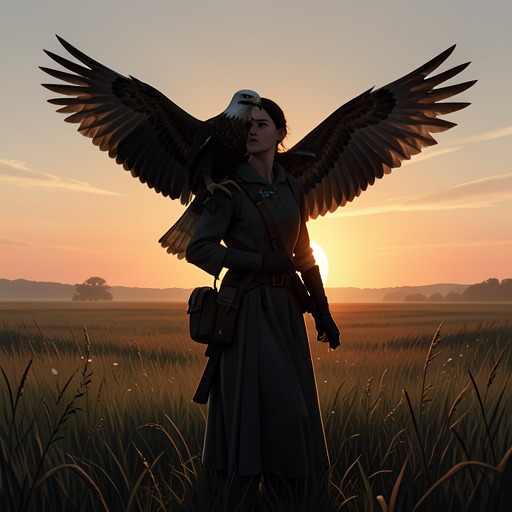
Hawking addiction
H is for HawkHawking addiction names the pull Helen Macdonald discovers in hunting with Mabel: the trained effort of falconry ends in a deliberate surrender of control, and the uncertainty of what the hawk will do becomes the source of an absorbing rush. The experience is not simply close observation of a bird. It alters Macdonald’s sense of time and attention, draws her into the hawk’s perspective, and leaves her facing the consequences of hunting as a human participant.
The social history of hawking
Macdonald’s account situates her attachment to hawking within a history of unequal access and unequal esteem. She had once preferred falcons, admiring their speed and grace, while finding goshawks unsettling. She later understood that falconry’s praise of the peregrine was entangled with who could fly it: falcons need extensive open country, such as grouse moors, partridge estates, and large farms. Those landscapes were more accessible to the wealthy and well connected. A historical falconry writer explicitly described possession of noble falcons as an aristocratic privilege.
The solitary trainer of goshawks and sparrowhawks, by contrast, had often been treated with contempt in falconry writing. The disparagement extended from austringers to their birds: goshawks were represented as difficult, antisocial, and ill-tempered, while peregrines received the language of nobility. These judgments make hawking addiction more than a private fascination in Macdonald’s account. The birds and practices that attract her are also situated within a cultural hierarchy that associates open land and prestige with falcons, and solitary work with goshawks with lower status.
Gender, temperament, and training
Macdonald’s reading of falconry books sharpens the social critique through the repeated characterization of female goshawks. After a man suggests that she and her female hawk naturally understand one another because both are female, she rejects the idea that their sexes explain the bird’s behaviour. Yet the encounter prompts her to examine what falconers have written about goshawks. Several later writers describe them as sulky, contrary, or eager to frustrate their keepers, turning difficulty in training into a supposed defect of the bird’s character.
Earlier accounts offer a different model. Seventeenth-century writers describe goshawks as shy and fearful, but also sociable and affectionate when treated with kindness and consideration. Their behaviour is not reduced to a fixed, irrational temperament: harsh handling can provoke a response, and the keeper is responsible for meeting the hawk’s needs. One writer presents himself as the bird’s friend and playmate. Macdonald prefers this account because it acknowledges the hawk as self-willed and different while making the falconer answerable for the relationship, rather than blaming the bird for every difficulty.
The rush of relinquishing control
After hunting with Mabel, Macdonald distinguishes the experience from birdwatching. She likens it instead to gambling: skill and preparation are poured into an undertaking, but once the hawk leaves the fist, its outcome cannot be controlled. The possibility that the hawk may catch its quarry is real, but never assured. That interval of uncertainty—when preparation gives way to chance—is the lure. Macdonald describes its attraction as a loss of self within an outcome at the world’s mercy, and recognizes that she has found an addiction in hawking, one she fears she does not want to leave behind.
The experience also changes how time and attention feel. A hunt lasting less than an hour seems to stretch across years; the surrounding world recedes even as each detail becomes intensely present. In this heightened state, the movement of the hawk and the search for prey organize Macdonald’s perception. The pull is therefore both external and inward: she follows what the hawk does, while the hunt temporarily displaces her ordinary orientation to the world.
Hunting, identification, and responsibility
Macdonald describes the hunt as drawing her beyond ordinary human attention toward the hawk’s way of moving through the landscape. Hunger, desire, and the search for prey become the lines directing her own movement; the next moments matter more than past or future. She recognizes that this alignment can make hunting intelligible to her despite her general reluctance to kill animals. Her perception changes through participation, not detached observation.
The capture of prey reverses that identification. When Mabel catches an animal, Macdonald’s attention returns to the human responsibility involved in the hunt. She intervenes to prevent the animal from enduring prolonged suffering, and understands this responsibility as inseparable from having followed the hawk. The contrast gives hawking addiction its central tension: the hunt offers an intoxicating surrender of control, but its consequences demand deliberate human action. The attraction does not remove responsibility; it makes Macdonald experience how closely exhilaration, dependence, and accountability are joined.